contact@gdacameroon.org
Rue 2.038, Tsinga, Yaounde 2 – Cameroon. No. 159, Harmattan Building


Phone:
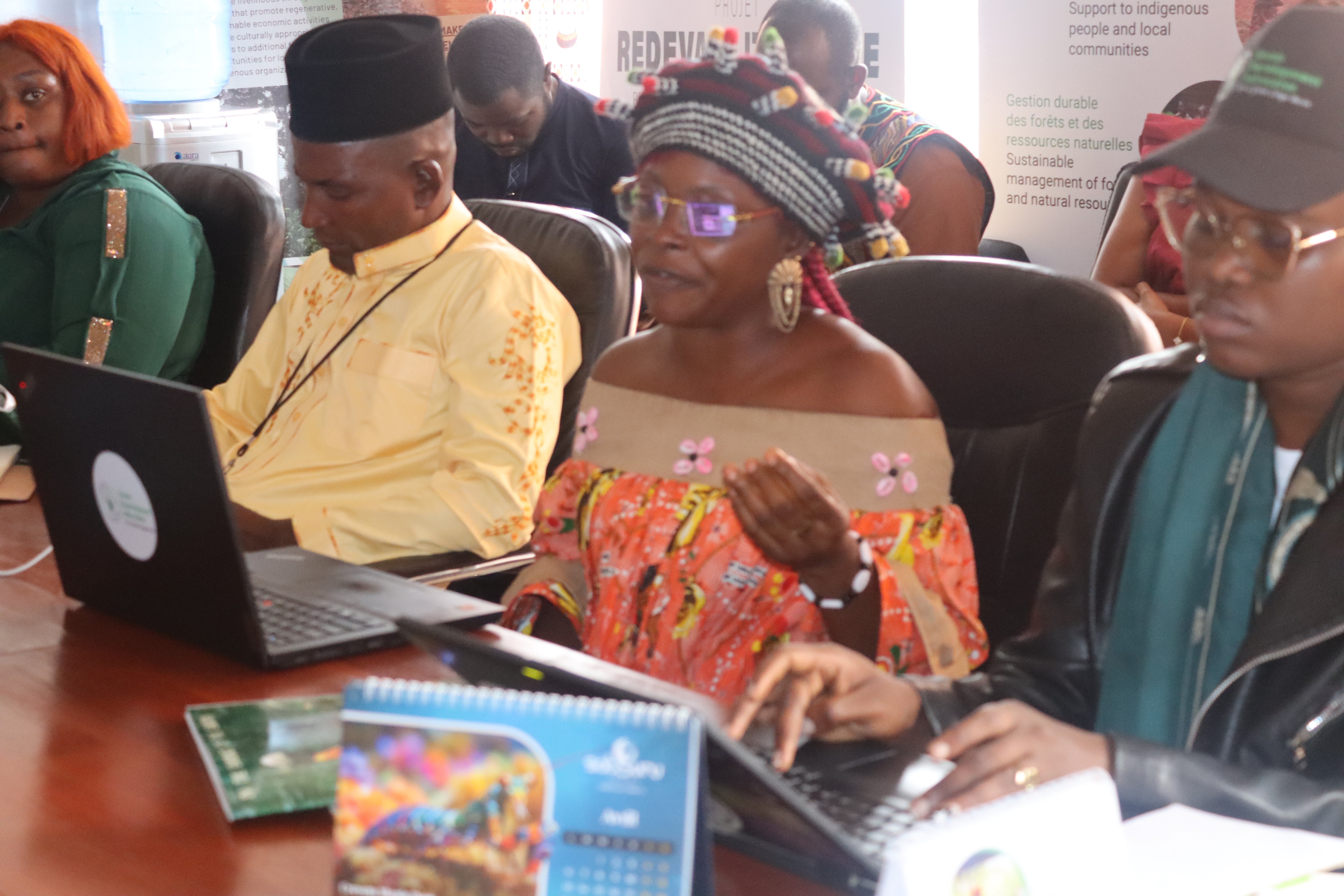
IPLCS cry out against forest destruction, displacements and marginalization
The opportunity was double fold for the indigenous populations around Mintom in the Dja et Lobo Division and the local communities of Batchenga, Ntui, Campo and Kikot in the South region of Cameroon. A photo-book launch organized by GDA and #Womin Africa Alliance in a webinar Thursday 19 March 2026 was another moment to highlight the importance of the forests and the dire need to take into consideration not only the natural resources that these forests contained but also the humanity that across time has been there, nurturing and protecting these forests to the level that capitalist multinationals are now feasting therein with only little regard for their welfare.
The photo-book titled “In the embrace of the Earth" (https://www.gdacameroon.org/media/attachments/2026/03/24/womin_photobook-digital-spread-2.pdf), depicts the Baka indigenous people engaged in several daily activities and feeling comfortable in the forest - their natural habitat - embracing their entire livelihood, reflected in the memories of the past, the joys of the present and the aspirations of the future.
This launch preceded the International Day of Forests, Saturday 21, whose theme “ Forest and economies” was articulated in the Thursday webinar from the testimonies of the participating Baka community representatives, as well as those of the local communities affected by the extractive projects in #mining, #agriculture, logging and #hydro-power generation in the South Region of Cameroon.
The cry of these communities hovered around the marginal considerations taken by the project owners as well as the administration providing the concessions, without due regard to the strict respect by the exploiting companies of their commitments undertaken beforehand as well as the environmental fallouts of the exploitation process.
To the indigenous community in Mintom, not only have they been driven out of their ancestral habitat within the forests but they have obliged them to live within communities that have little respect for their traditions, provide little or no space to engage in their cultural and traditional activities and also do have the tendency to undervalue them and acculturate them; “our indigenous language is rapidly disappearing as the Baka are now confronted with speaking different languages especially those of the dominating Bantu communities; our lands and forests are taken away; many of our villages and chieftancies are are not recognised by the administration, our children are now being deported away from the homes and many find it difficult to find their way into the forests; we just find ourselves learning the ways of others and the others do not show interest in learning our ways, is that right?”asked Ndeloua Luc addressing participants on the Webinar.
Nke Jeanette from Ntui on her part would even envy the Baka for being only relocated to other sites where there still exist some forestlands, considering that in Ntui, they do not have any forest again; “ we had our river bordered on both sides by the forest, but now the whole area is devastated. The construction of the Nachtigal dam had the whole forest area depleted. We do not have anything like a forest now whereas the forest surrounded our villages and I felt very comfortable within since all what we needed was available in the forest. The forest was the source of all our economic activities. When the dam came, we lost everything and we find it difficult to harvest even the leaves we used to wrap our local foodstuff with, as well as those that served as vegetable for our meals. Now, we are only using the training we received from GDA to make local manure as fertilizer for our small farms".
In the Campo area, it is either CAMVERT, the agro-industrial holding or SINOSTEEL, a mining company that the communities have to confront by the day; ” As soon as these companies got installed in Campo, they cut down all our trees and you know very well how the forest is very important in our lives. we gather our herbs from these forests to treat ourselves, and now that these trees have all been destroyed we find it difficult to gather herbs to help facilitate the easy delivery of our babies. We have also realised a drastic change of the climate from the time these trees were destroyed and we do not know how to manage the situation. We now have very limited space to make our farmlands as we observe an increase of the population with the relocation of the Baka indigenous people close to us. The projects have taken most of our lands".
The Green Development Advocates has in collaboration with some other civil societies been advocating for the inclusion of the concerns of IPLCs in the national legislation, if government really has any intention to demonstrate its attachment to the welfare of its citizens. This pressure has had to pay off as seen in the just enacted Forestry and Wildlife law. According to Mongo Marius, the GDA legal expert addressing participants in a presentation of the GDA Guidelines of the 2024 Forestry Law; "The law has addressed some of the preoccupations of IPLCs, nevertheless, there is still quite much to take care of as it is observed that some of the advantages in the abbrogated law were not introduced in the new law. we hope and expect that the texts of application which are being drafted would help to assuage some of the shortcomings while waiting for further modifications of the law” he stressed.

Ne summo dictas pertinacia nam. Illum cetero vocent ei vim, case regione signiferumque vim te. Ex mea quem munere lobortis. Duis aute irure dolor in reprehenderit in voluptate velit esse cillum.
