Asserting the Power of Women in Influencing Outcomes
The expression, “What a man can do, a woman can do better,” is no longer novel. It has become an established expression in the feminist lexicon of contemporary affirmative action, as demonstrated by testimonies of women-led initiatives across the continent.
It was therefore hardly surprising to hear this slogan at the WoMin-sponsored Women Climate Assembly (WCA), an emerging eco-feminist movement that has, over the past four years, championed grassroots action against climate change, particularly through advocacy for women's rights to land and natural resources.
Interestingly, the slogan was not expressed in a spirit of defiance or competition with men. Rather, it conveyed faith and determination to work in synergy with them in confronting what participants increasingly recognise as an existential challenge.
Motivated by the impacts of decades of development projects financed by development banks and multinational corporations across Africa, WoMin African Alliance and its partners have intensified demands for reparations for affected communities. They equally call on development financiers to place people's interests at the centre of their investments.
Against the backdrop of often disappointing development outcomes associated with projects financed by the African Development Bank (AfDB) and other multilateral financial institutions, WoMin questions the capacity of conventional, capitalist-oriented development financing to address the structural conditions of underdevelopment in Africa.
The organisation challenges the assumption that increased institutional financing and large-scale investments necessarily translate into meaningful socioeconomic transformation. It argues that prevailing development models frequently prioritise capital accumulation, economic growth and resource exploitation over the rights, livelihoods and wellbeing of grassroots populations, particularly women and Indigenous Peoples and Local Communities (IPLCs). Research examining the outcomes and impacts of these projects reportedly provides empirical support for this position.
Consequently, WoMin advocates grassroots women's empowerment, emphasising that women cannot afford to leave their welfare, survival and aspirations entirely in the hands of others. They must participate actively in shaping Africa's development, both in sharing its benefits and confronting its costs.
The urgency of this affirmative action is heightened by environmental degradation and climate change, whose adverse consequences disproportionately affect women and children, particularly in resource-dependent communities. Their vulnerability is deeply rooted in existing socioeconomic inequalities. Empowering women to confront these challenges is therefore not merely a development priority but an existential imperative concerning their livelihoods, dignity and future.
Rallying Stakeholders on Climate Action
The Women Climate Assembly is a WoMin initiative designed to mobilise grassroots women in demanding just climate policies, particularly in mitigation and adaptation. Its underlying conviction is that climate resilience cannot be effectively achieved without women's meaningful participation in decision-making and policymaking.
The Assembly therefore seeks to transform grassroots women's concerns into a collective force capable of influencing government policies and the practices of multinational institutions and corporations exploiting Africa's forests, rivers, minerals and other natural resources, often with inadequate benefits accruing to affected populations.
It is consequently more than an awareness-raising platform. It aspires to become a mass eco-feminist movement that places women's lived experiences and aspirations at the centre of environmental governance and climate justice.
The Yaoundé Gathering
The Yaoundé Assembly was the fourth in a series of gatherings, following Port Harcourt in 2022, Lagos in 2023 and Saly in 2024. WoMin regards these previous assemblies as foundational encounters that prepared the ground for a more consolidated movement.
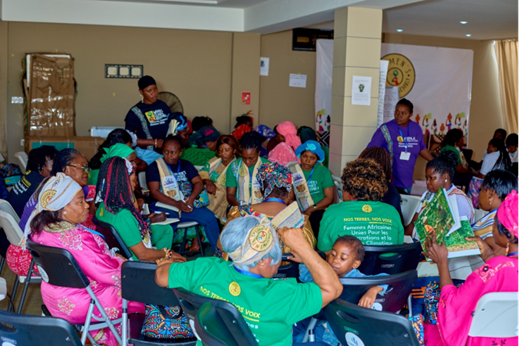
The Yaoundé gathering attracted considerable participation from different countries and grassroots organisations. Particularly remarkable was the enthusiasm with which Indigenous Peoples and local community representatives presented their grievances before government representatives and the media. Their testimonies offered compelling evidence of how climate change and environmental degradation affect communities at the grassroots.
The expectation that Yaoundé would mark a significant milestone in consolidating an eco-feminist movement became increasingly evident throughout the four-day gathering. Participants expressed their determination through speeches, demonstrations, slogans and personal testimonies, collectively conveying a resolute commitment to defending their environments, livelihoods and fundamental rights.
Drawing the Battle Lines
The battle lines were drawn primarily in defence of women's lands, natural resources and livelihoods.
The first challenge is directed at governments that frequently enter into bilateral agreements with foreign states and investors in pursuit of national development, sometimes without adequately considering the interests of affected populations. Such arrangements may grant extensive exploitation rights over valuable natural resources while leaving local communities to bear disproportionate social and environmental costs.
The second challenge concerns international institutions that formulate policies and legal frameworks intended to protect humanity but often demonstrate limited willingness or capacity to ensure their effective implementation, particularly when national sovereignty becomes an obstacle to enforcement.
The third front targets multinational corporations whose pursuit of maximum profits frequently overshadows their responsibility towards Indigenous Peoples and local communities affected by their operations.
The movement equally confronts national elites who, through corruption, embezzlement and self-serving arrangements, compromise collective natural heritage for personal gain, often at the expense of present and future generations.
Finally, the battle must also be fought within local communities themselves. While communities rightly denounce external forces responsible for environmental injustices, they must equally recognise the consequences of their own everyday activities on environmental sustainability. Environmental protection cannot be demanded exclusively of governments and corporations; communities must also assume responsibility for respecting and safeguarding their natural surroundings.
Having drawn these battle lines, the WoMin-inspired Women Climate Assembly movement acknowledges that the struggle ahead will not be easy. Nevertheless, its determination remains firm: to continue mobilising women, influencing policies and challenging practices that undermine environmental and social justice until its rallying call, “Climate Justice for Africa NOW,” becomes a reality.
Ne summo dictas pertinacia nam. Illum cetero vocent ei vim, case regione signiferumque vim te. Ex mea quem munere lobortis. Duis aute irure dolor in reprehenderit in voluptate velit esse cillum.